
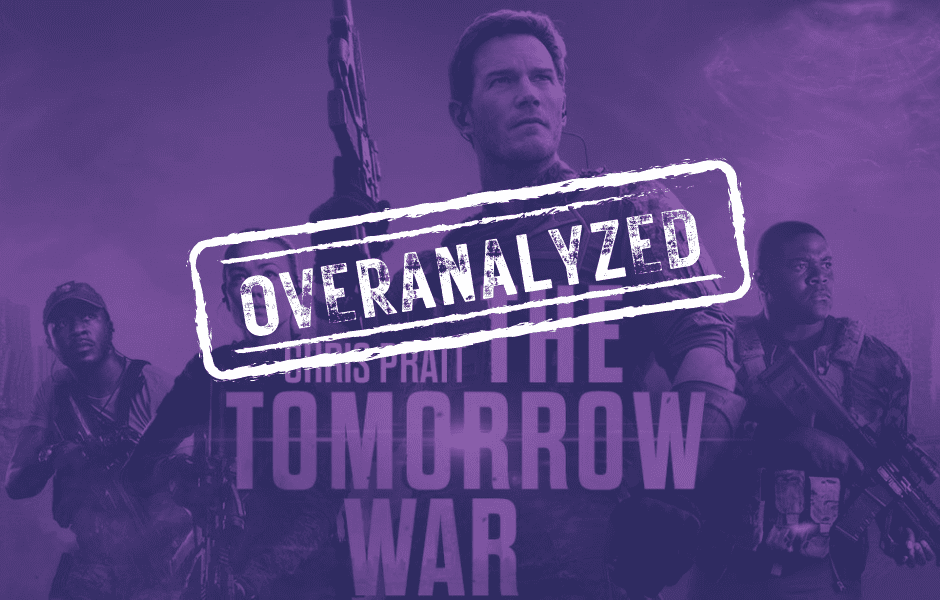
Soldiers plummet to their doom from a portal ripped open in the sky. They land in a pool and surface to see a war-torn city on fire. Aaaand I’m bored. I’m about to write this movie off as another action movie I’ll forget about in five seconds. But then things change. It rewinds to 28 years earlier and the writers do something no writer of an action movie has done in a while…establish the character and the theme—aka the moral lesson.
We see Dan, the protagonist, in the present day, on an important phone call that could land him his dream job he went to college for. While on the call, we find out about his background of being a soldier and teacher as he tries to persuade the guy to hire him. Dan makes it sound like he is qualified. Usually I hate exposition, even poorly disguised in dialog, but this worked for me because the protagonist was using the exposition to achieve his goal. When the exposition is active and breathing, it feels more real and deserves to be there.
Theme gets us thinking
Dan is put on hold, so he goes into his house and chats with his wife and says hello to his cute daughter, Muri. He cares about his family, but he seems to care more about this dream job, as he’d rather be taking interview calls on Christmas Day while his family is partying without him. While he talks to his wife, Dan notices a card on the counter from Dan’s father addressed to Muri. The wife suggests talking about it later, but Dan tosses the letter in the trash stating, “He forfeited the right to be a grampa when he chose to abandon your husband.” He kisses her and leaves to talk to the interviewer, completely shrugging off her suggestion to talk about his dad later.
We now have a hint of the theme: everyone deserves a second chance. I have questions too. Like, why did his father abandon him? Is this going to influence the movie later or is just a throwaway character backstory? Will Dan forgive his father or stay bitter? I want to know! Themes can get us thinking or “chewing” on the possibilities of the future story. That’s where we want to be: thinking about the story and the impact the hinted theme will have on it, to want more, rather than waiting for the next plot point to drop. More so, we like focusing on how the theme will affect the protagonist. Themes promise under-the-surface rewards we’ll enjoy.
So why do many action movies and books have no sense of theme or moral lesson? Laziness and an ignorance of what we appreciate, mostly. No writer ever wants to take the time to establish it or even have one, because too much plot and flashy explosions are happening, and we only care about that stuff, right? Wrong. Also, to have a theme that promises change means the protagonist is human and has a flaw. Why would the writer want their precious character to change if they’re perfect? Especially with the woman power movement lately, every woman protagonist has to be perfect, because apparently, strength is never having to struggle with your own flaws and overcome them. It’s so much easier to just be Mary Sue and do no wrong. Yeah, that’s a character I want my daughter to emulate…
Life is struggle, people. Men and woman both need to struggle to be better. If your main character is perfect, no matter what gender, you did it wrong. Period…unless you’re writing about Jesus. Then carry on.
Themes make us care
The head honcho and the interviewer say Dan doesn’t have the private sector experience they wanted. They hang up and Dan is left stunned. His dream is unreachable now. He says to himself, “Course, you’re not the guy. You’re an idiot.” He tosses his papers and slams his mailbox and trash cans out of frustration. The writers knew not to leave the scene too early, so they let us see how hurt Dan is by losing his dream job opportunity. We see how much this actually meant to him. He cares, making us care.
That’s what the theme does. It makes us care, because a theme promises the protagonist will grow—or not grow. Growth and change is intoxicating to us. Don’t believe me? Watch any “satisfying video compilation” on YouTube and see what pops up: someone cleaning something from dirty to clean. Our brain gets a rush of pleasure when we see change, and when it’s a character we like, even better.
Guys, this is how to nail a first scene or chapter. Not only did the writers make Dan lovable in the first two minutes, but by four minutes, I care about his dreams being crushed. I want him to succeed, which means the writers achieved the goal: to make me care about what happens next. Not about the overall plot, but about the protagonist, and what is a plot without its deep characters? Basically, a beautiful stage with mannequins dancing soullessly.
“I am meant to do something special in my life.”
Dan goes back inside to sit with his daughter and wife. They are watching a soccer game and the daughter is talking to Dan, but he’s not all there. He points to the tv and says to his daughter, “See these people playing soccer up there? They are the best in the world. Can you believe that?” The daughter responds, “I want to be the best, like you are at science.” Dan sadly chuckles at that and says, “You know what you need to do to be the best? You need to say to yourself, ‘I will do what nobody else is willing to do.’” The daughter nods and Dan says to his wife, “I am meant to do something special in my life.” The daughter responds “Everything is gonna be OK, daddy.” He laughs and gives her a hug, “I think I’m supposed to be saying that to you, sweety.” Wow! At six minutes, I care about this family more than most characters I have watched in full movies as of late. You see this kind of care in comedies and rom-coms, rarely action movies.
Let’s unpack this brilliant establishment of theme. “I will do what nobody else is willing to do.” That’s a determined, passionate outlook. He is driven. And I can tell he is saying it to himself more than his daughter. Dan then said “I am meant for something special in my life.” This shows me he is discontent with his life and thinks he needs to change something to be great. But at what cost? That’s how they link the two themes rather seamlessly throughout the movie. More on that later.
Connect with the protagonist first
The soccer game is halted by a group of time traveling soldiers with guns asking people to join their fight against alien Whitespikes in the future. Fast forward twelve months later, and there are civilians being drafted to be sent through jump points to fight this war that hasn’t even happened yet. There are war protests all over the world. The television gives all this information, but it’s still intriguing, because I’m now curious about how this will affect the protagonist I care about. Imagine if all this happened without the first five minutes of the film. I wouldn’t care about anyone or anything. I know the world won’t blow up, so now I’m just waiting for explosions to go off, so I stop being bored. This is why it was crucial that the writers established the character first before throwing him into the chaos of the inciting incident.
It’s this simple. You walk down a street and see some stranger being mugged. “Bummer! I’ll call the cops and move on with my life,” you think. Now what if you see a new friend being mugged? Someone you had bonded with on the last bus ride? Things change, don’t they. Now you jump in and help. Now you are scared and sad for them. Why? You only met yesterday. Here’s why, and it’s the same reason you need to spend at least five minutes—or a chapter in a book. When we meet someone in their normal environment and see their personality, hear about their goals or dreams, that makes us connect. If the movie throws a protagonist into a fight or world war minute one… no one will care, because we don’t even know the protagonists who’s in danger.
The past hurts, but it helps the theme greatly
Dan is shown teaching a class and connecting with his students, but they don’t want to talk science. They have no hope, knowing that in thirty years they will all be dead. Dan encourages them to focus on science and innovation that will give them hope for a better tomorrow. An alert sounds on Dan’s phone and he is called in to test for the draft. He passes. They attach an armband to his wrist that will make him jump and record his vitals. He asks them what made him qualified and they say that he will die in seven years and they won’t tell him how. Again, another intriguing question. He is told he has twenty-four hours before being sent to base. Now, did we know he was going to be in the Tomorrow War? Yes, but we care now because they set up the character and his goals and cares earlier.
Dans visits his wife who works at a help center for vets from the Tomorrow War. The writers did something cool and foreshadowed a touch of what the protagonist will be facing. A vet says “I still can’t get that clicking out of my head…always clicking.” The wife tries talking Dan into running away with them, but he won’t. The wife begs him to ask his father for help, which Dan refuses, but eventually caves for his wife and daughter’s sake.
Dan’s father is introduced as a stand offish mean type. He hardly recognizes his son and criticizes him from the get go. Before long, they start to argue and Dan accuses the dad of abandoning him. The father claims he left because he didn’t want to hurt his family while he fought his PTSD. Dan says he left because he was a coward. Dan says his father will never get a second chance with his granddaughter and storms out.
Because we know the past, the theme makes more sense now. After all, why do we as humans have strong beliefs and lies we tell ourselves? Why do we have flaws we cling to? Usually, it’s because of the past influencing our view of the world. It’s the same with stories. The protagonist’s lesson they need to learn comes from their past and validates the lie they believe. If the protagonist struggled with something, but we never knew the reason why, then it’s harder for us to empathize with them. Dan’s father sharing about the past, not only gives us a reason to feel for the protagonist, it gives us a reason to side with them even when their moral compass is off. Yes, good storytelling is mastering the craft of manipulating people’s feelings.
Fighting in the future
Dan tells his wife he has to fight the war, and she tells him to tell Muri. He does and promises he’ll be back. But the chances of that are slim. The daughter is understandably upset. Not only do we care about Dan. Now we want him to survive more, because his daughter, Muri, wants him to survive. It doesn’t help that earlier, Muri was upset because she had a nightmare that her father was drafted. Oof. My heart. These writers took care to foreshadow necessary things. If you want someone to care more, hint what’s coming beforehand.
The alarms sound six days earlier than normal because the research facility in the future is being attacked. They lose that facility; they lose the war. Dan and his team are jumped into the future. We are told Whitespikes are everywhere, but we haven’t seen them yet. We have heard the clicking and distant movement of them. They shuffle through building hallways, seeing only spikes protruding from the wall and lots of blood. They find the researchers dead and hanging upside down from a ceiling. This is a perfect way to introduce unknown creatures or monsters in any story–slowly. Bit by bit, till the full reveal satisfies our curiosity, like taking a bite of chocolate cake for the first time. Make it a sought after reward.
Command tells them to go for the research section to get blue vials. Dan finds them and they get out. They head down a stairwell too slowly for my heart to take. I’m on the edge of my seat. Dan hears a small clicking sound, then he shines a flashlight up to the ceiling. We see, first, the creepy tale and then the full hideous, Whitespikes…many of them. They attack with a skittering, vicious fury. Gun fire and the action begins. Man, do I care more about it too, because they did such a good job setting up the aliens in all their icky glory, the stakes, and the character you can’t help but root for. They manage to kill one of the Whitespikes but many more swarm them, killing most of their team.
Weaving plot and theme together
Dan meets the commander who is Colonel Muri Forester…yeah, I should have seen it coming, I know. But my mouth hit the floor. The commander is his daughter. He tries to hug her, excited that she’s alive in the future, but she steps away from him before he can. Whaaaaat? Why would she do that? She should be happy to see him alive, so why isn’t she? Like the talented writers they are, they don’t answer these questions Dan—and myself—are asking. We have to wait. Patience is a virtue and a good writer pushes the us to wait and earn the right to find out the juicy truth at the opportune time.
Muri tells him she went to MIT and started the group he’s in: research development. He says he’s proud of her, but she acts like that hurts her more than makes her happy. He asks her why she brought him there, and she says, “I’ll tell you when you need to know.” They go to capture a female Whitespike who is the key to exterminate the whole species and save the world. On the ride, Dan asks Muri about what happened prior to his death back in his timeline, but Muri shuts the topic down. There’s something she is hiding and man, do I want to know.
They capture the female, but Dan disobeys orders to do it by leaving the chopper to help save Muri from being eaten. Muri is ticked and Dan says that he had to defend his daughter. She opens up suddenly and says, “I used to want to be like you.” She breaks down and tells him he abandoned them. He separated from her mom at age 12, promised everything was going to be fine, then divorced her mom at age 14, leaving them completely. She cried, “You never seemed happy with your life.” Muri finally reveals that he got into a car accident and died, but she never left his side, even at his deathbed. She always wished that he saw her and stayed with her.
This was a brilliant, heart-wrenching scene. Let’s ruminate on this for one second. His future daughter tells him his sins and his faults and what it does to her. His whole point of going to the future is to make a better place for his daughter to be in. But, apparently, he was going to end up ruining her life without the help of aliens by abandoning her. Hm…that sounds familier. Oh yeah, Dan’s father abandoned him, so this destiny really must hurt Dan. Now he has…wait for it…a second chance to make things right if he gets back home alive. Now the question is two parts: will he accept the change he has to make in himself and will he live to have that chance? We don’t just want this character to live because, death is sad. We want him to live so he can change. Don’t we all wish that for ourselves, a chance to make things right? Well, that’s what we want for this guy too.
This is the perfect example of weaving character intrigue and plot together like a beautiful tapestry. This is my goal as an action writer to accomplish. There’s a reason many action stories have no depth. It’s hard to weave a good character arc and themes into a heavy-hitting plot and make it work without being cheesy or overused. Combining the theme of second chances and the plot of time travel is…brilliant. Kind of like a futuristic sci-fi Christmas carol, if you will.
“I will do what nobody else is willing to do”
After that blow up of emotion, Dan and Muri have some bonding time as they do science things to learn how to kill the Whitespikes. Muri tells him she will give him the toxin for him to create a way to kill them back in his timeline, leaving her to die in her timeline. She quotes “Do what others aren’t willing to do.” Which is a very cool nod to the beginning of the story. He promises he will, but he also promises he’ll save her in the future timeline too. The toxin finally reaches 100% success, then Whitespikes breach the perimeter.
Dan and Muri fight hard and try to get to a helipad, but Muri is brutally wounded. The base explodes and fire erupts everywhere. Whitespikes close in. The world seems to blow up around them as Dan realizes he won’t be able to save her like he promised. Muri tells him he has to get the toxin back to his timeline. Muri apologizes to him for being harsh before, and she says she’s glad to see her father as the man she remembered—her hero. *Sniff* This poor guy has already failed his daughter in the past, and now he’s going to fail her in the future. But there is hope. She dies while Dan is forcefully jumped back to his timeline.
The final act
Dan wakes up and tells them to mass produce the toxin and send it back to the timeline. But the jump link is destroyed, so they can’t. Now the question isn’t—at least in my mind—does he save the planet? Duh, of course he does. My question is, will he use what he has learned and appreciate what’s in front of him? Will he stick with his family and be content to be awesome in just his family’s eye? Will he give himself a second chance? With a good theme, we tend to be more excited to see the arc wrap up rather than the plot.
His wife and daughter are thrilled to see him, but he can’t seem to form words. He looks at Muri like she’s barely there. He gives her a big long hug. I almost cry. It’s almost like you can tell what he’s thinking. Dan opens up to his wife that Muri was in the future and that the toxin she developed will help, but he can’t seem to figure out how to use properly to prevent the future attack. With the help of his friends and family, Dan figures out where the Whitespikes came from. Dan’s team tries to convince a politician to fly men to Russia to kill the Whitespikes, but because “politics” and the world is on the brink of war with itself, he says no.
Proving the protagonist has grown and is learning the theme, Dan swallows his pride and asks his father to help fly them to Russia. The dad appreciates his son asking him for help and agrees. They find the Whitespike’s spaceship and Dan tells them it’s better they deal with the aliens now rather than wait for polititions to argue about what to do. Dan says he needs to save Muri and that they can give the world a second chance at survival if they kill the aliens now. He looks to his father and says “second chances are hard to come by.” We can see that Dan is learning that, just as he wishes for a second chance to prove to Muri he can change, he should give his father a second chance too.
They kill all the Whitespikes, accept one. The female Whitespike escapes, and Dan and his dad go hunt it down. The father tries to sacrifice himself to save his son during the fight saying “I’m sorry son…for everything.” But Dan jumps in to save his dad in the nick of time. They kill the female Whitespike, and it’s satisfying when they do. Dan gets home and hugs his wife and daughter, then introduces Muri to her grandfather. The last words said are from Dan as he smiles at his family . “Turns out my best future is right in front of me.” Dan saved the world, and—possibly more important—he completed his character arc and learned the theme. He has grown and won’t ever be the same again.
The theme wraps up a story with a nice pretty bow
Why was this end more satisfying compared to other action movies? He saved the world, but so does every hero in their action story. So, what’s the big deal? Listen up. Life is much more than the outward rewards. Whether you believe or don’t believe in God, the successful films prove that there is a desire for all of us to root for the person who changes spiritually for the better. Life is so much more than getting the dream job, vanquishing the villain, saving the world, or meeting the love of your life. It’s about changing yourself and using that new self to help others. What is life without change? Though this wasn’t a Christian film, I appreciate they taught a biblical lesson of forgiveness. And that gives a theme the most power. A moral lesson can be subjective depending on the author, but when God’s word is involved, the moral lesson is objectively true and has a sturdy foundation not rocked by anyone.
This is why themes are pivotal to every story, guys. Dan won the war, but better yet, he won his inner war. He forgave himself for hurting his future daughter. He didn’t just shrug his shoulders and say, “Oh well, I guess I’m a jerk in the future.” He forgave his father, giving their relationship a second chance. When we see the contrast of a man who can’t stand a letter from his father, to letting his daughter hug her grandfather, that is a wonderful, satisfying thing to see. When the inner self wins, we all win.
Overall, this was an amazing action-packed film with a surprisingly deep message interwoven into it. The setups and payoffs were pretty well done. The creatures were foreshadowed and developed nicely. I’ll admit the plot holes in this movie were…many, almost too much to count, but I didn’t even care because I was too enthralled with the protagonist’s inward journey…and the cool alien creatures trying to rip his face off. Some of the scenes needed to be paced and acted better, but I’ll blame the editor and director on that one.
Long story long guys, don’t let action stories be shallow. Put in a good theme, a good character, and throw them into chaos. You’ll care more and your audience/readers will too.












Well done, Megan! Your blogs are improving! This was very informative and clear. Thank you!
Thank you! 🙂
Nicely said!! Agreed!!